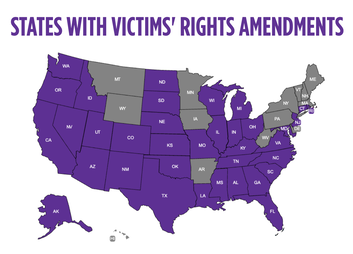
Arkansas is one of only 14 states in the country without a crime victims' rights amendment in its state constitution. Currently, crime victims' rights are only provided by statute. A constitutional amendment would bring meaningful, enforceable rights for crime victims in the state. These protections would be guaranteed by the highest law of the state of Arkansas, ensuring that victims are treated with respect and dignity, have participatory rights throughout the criminal and juvenile justice proceedings, and enjoy the legal ability to have their rights enforced.
Specific enforceable protections (as included in 2025 HJR 1009) would include the rights:
To be treated with fairness and respect for the victim's privacy and dignity, and to be free from intimidation, harassment and abuse throughout the criminal or juvenile justice process;
To be reasonably protected from the defendant and anyone acting on behalf of the defendant;
To have the safety of the victim and the victim's family considered as a factor in setting the amount of bail and the conditions of release for the defendant;
To refuse an interview, deposition request or other discovery request and to set reasonable conditions on the conduct of any interview, deposition or other discovery request to which the victim consents;
Upon request, to reasonably confer with the prosecuting attorney regarding the case against the defendant;
Upon request to receive reasonable notice of all public proceedings and delinquency proceedings at which the defendant and the prosecuting attorney are entitled to be present and to be present at all public proceedings and delinquency proceedings;
Upon request to be reasonably heard at any public proceeding or administrative proceeding in any court or other venue involving the release, plea, sentencing or any other proceeding which implicates a victim's right, to include delinquency proceedings and post-conviction release proceedings;
To the timely disposition of the case following the arrest of the defendant;
To provide information to a public officer or employee conducting a presentence investigation concerning the impact of the offense on the victim and the victim's family and to see any sentencing report and recommendations before the sentencing of the defendant;
Upon request, to be informed of the conviction, sentence, place and time of incarceration or other disposition of the defendant, the scheduled release date of the defendant and the release of or escape by the defendant from custody;
To full and timely restitution;
To the proper return of legal property when no longer needed as evidence;
Upon request, to be timely informed of and to be present at all post-conviction release proceedings, to provide information to the post-conviction release authority to be considered before the release of the defendant and to be notified of any post-conviction release;
To have the safety of the victim, victim's family and the public considered before any post-conviction release of the defendant;
To have all monetary payments, money and property collected from any individual who has been ordered to make restitution first be applied to pay the amounts ordered as restitution to the victim;
To be informed of the rights enumerated in this section and have them available to the public;
To have standing to assert the rights enumerated in this section before any court with jurisdiction over the case involving the defendant and have them promptly considered.
Because it's the right thing to do. Arkansas is one of only 14 states in the nation that does not provide constitutional protections to crime victims. Every state surrounding Arkansas has afforded its citizens this respect. Crime victims across the country are overwhelmingly united in wanting justice and due process throughout criminal justice systems in America. Arkansas should also listen to its crime victims. It is time to ensure meaningful, enforceable rights and access to justice for all of Arkansas' people by putting them in the state constitution.
No one would ever consider protecting the rights of those accused of a crime by anything less than the constitution. Crime victims deserve the same dignity, respect and access to the state's justice systems. To elevate victims' rights, they must be in the constitution. A right protected by statute will never be as powerful as a constitutional right; nor will it ever be viewed by the community or courts to be as powerful and deserving as those listed in the constitution protecting an accused. Having constitutional protections like the accused gives crime victims equal access to the criminal justice system as participants with a voice. The participatory rights of crime victims merit inclusion in the highest ideals and tenets of a state.
Nothing in the language of the amendment supersedes any existing right of an accused or convicted person. Those accused of crimes or convicted will continue to enjoy existing constitutional protections. A victims' rights amendment will require courts to consider the rights of a victim under the constitution the same way they do those of the accused. Should conflicts arise, courts are well prepared to balance competing interests. We already trust them to render thoughtful decisions based on the law.
In our system of justice, anyone can make allegations, but only those claims that conform to the law survive. Under a victims' rights amendment, law enforcement would retain its investigatory and enforcement powers, and prosecutorial agencies would retain their charging discretion and procedural control over a case. Judges would continue to control how cases proceed in their courtrooms. Victim status under the criminal justice system would continue to be determined by an investigating law enforcement agency finding probable cause that a crime had been committed, followed by a prosecutorial review and decision to charge the matter, and finally subject to judicial oversight in a courtroom determining the outcome. Only those the system already in place has determined to be victims will have constitutional protections.
A constitutional amendment will not require any different treatment of the accused. Law enforcement, prosecutors, judges and parole boards will continue to operate under their existing rules and ethical canons. The only difference will be that victims will have the opportunity to be present and be heard during the criminal justice process. The amendment will give the victim a voice in the existing system, not a veto.
There is already a protocol in place for law enforcement in Arkansas when it comes to making victims aware of their rights. Just as law enforcement makes the accused aware of Miranda rights, they also rely on "Laura's card" to inform victims. Any new relevant information can be added to the existing procedure.
The victim of rape does not care if her rapist is 15 or 50. The victim should have the right to be informed and participate in the case in whatever the case is heard and regardless of the perpetrator's age. A victim in a juvenile court must abide by all the directives of the court, including confidentiality. Furthermore, true to the purpose of juvenile courts, which is to hold juveniles accountable and afford them rehabilitation, the presence of the victim does both. It allows the juvenile to hear about the impact of the offense on the victim, and to understand why rehabilitation is important to prevent a reoccurrence.
To assume all crime victims want to be involved in the criminal justice system is incorrect. Many victims chose not to participate, especially when the offense is minor. However, those who want to participate should be allowed to do so. Elderly victims who had money scammed from them are victims who deserve rights. So is a family whose cherished heirlooms were stolen or vandalized. All crime victims experience trauma that is deeply personal and should not be subject to a classification as less worthy to participate in their case than someone else.